

Piano Tuning/Regulation


Piano Tuning – Pianos & Pianola Player Pianos
Why Does My Piano Need Tuning? How Often Does it Need Tuning? What If it’s Not Played Often?
- Piano strings are strung under tremendous tension, averaging 90 kilograms each. Hence, even if the piano is not played, the strings will gradually stretch with the passage of time, and the piano will fall out of tune. Pianos need regular tuning at least once a year to keep them up to pitch and playing the correct notes.
- In addition, piano strings may begin breaking and the copper windings of the bass strings lose resonance. Decades of exposure to seasonal changes can cause the wood of the soundboard, bridges and Pinblock to weaken. This causes loose tuning pins, poor tuning stability and further loss of tone.
- An acoustic piano needs regular care if it is going to work well. If a piano has gone five or ten years without being tuned, then tuning it once won’t be enough. Pianos get set in their ways as they age. A piano that hasn’t been tuned in a long time will go out of tune again very quickly.
- If your children are having lessons, it’s even more important that the piano is regularly serviced.
What to Expect at an Appointment at Your Home
Seat Strings onto Bridges -applied to eliminate false beats and achieve the best results for each note
Tune – Generally Tuned to A440 Concert Pitch
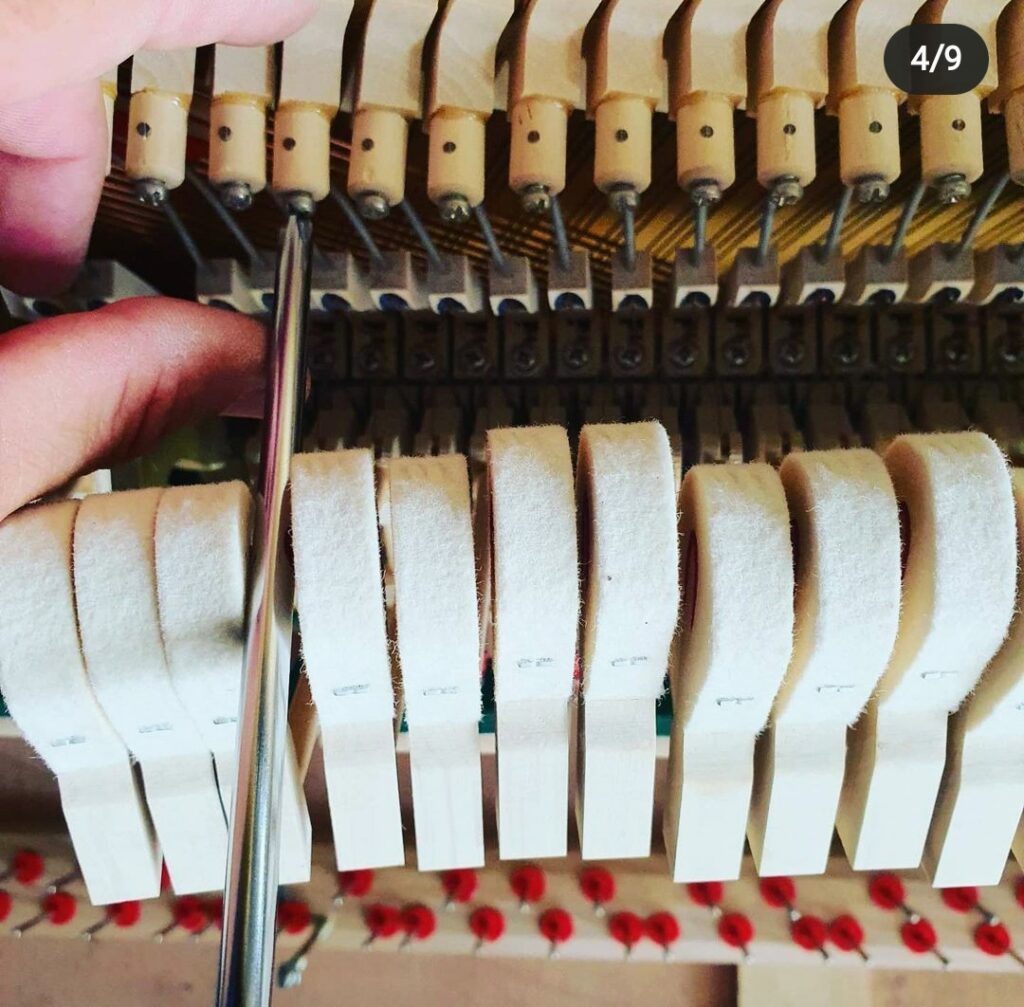
Voicing the Hammers – adjusts the tone of your piano
Removing the Piano Action for Lubrication – ensures all parts are working as freely as possible
Freeing up of any Sticking Keys and Explanation of how to stop this reoccurring
What if a string breaks during tuning?
Treble string – Can be replaced at the time of the appointment. A follow up appointment is required 3-4 weeks later to pull up the string. Why – Any new string continues to stretch until stabilised so will go out of tune quickly.
Bass String – This will need to be sent away for a new string to be made. A follow up appointment is required 3-4 weeks later to pull up the string. Why – Any new string continues to stretch until stabilised so will go out of tune quickly.
Note – There are 3 notes per string, so depending on where the string has broken 1 note can be muted and so you may not notice a huge difference to continue playing until the string has stopped stretching.
What happens if the Piano Requires Repairs?
We provide all repairs ourselves either within your home or if needed we bring the required parts or the whole piano itself back to our workshop.
This includes all repairs to the Piano Action, Keys, Strings, Tuning Pins, Pinblocks, Structural, Cabinet & Castor Wheels even your Piano Stool.
Regulation –I’m Not a Concert Pianist so why Needed? Whats Involved?
You’d be hard pressed to find somebody who didn’t know that pianos need to be tuned, but taking proper care of your instrument is a bit more involved than that, and it isn’t something that any tuner can do. An acoustic piano, be it a grand or an upright, contains not hundreds but thousands of parts, most of which are in the action (the mechanism between the keyboard and the strings), and most of those are small, precise parts that need to be positioned within a very small tolerance to function properly.
To regulate a piano is to adjust all the parts so that they operate uniformly and efficiently. The greatest difference between a new and a used piano is that the parts in the used piano have become worn and no adjustments have been made to compensate for the wear. The simplest way to visualize this is to think of a mechanical pencil. As you write you need to compensate for the wear on the pencil lead by clicking to expose more lead. Otherwise, the quality of the writing is progressively compromised to the point of not writing at all.
As parts in a piano wear, they no longer make proper contact with one another, compromising the action and its uniformity and predictability. This is very frustrating for all pianists and a great detriment to the beginning pianist. One obvious symptom of a piano in need of regulation is the inability to play softly. Sometimes when a pianist tries to play pianissimo, no sound comes out at all. This is because the hammers do not make contact with the strings unless a medium strength blow is delivered by the pianist. Another symptom is inconsistency in the amount of pressure required to play from one key to the next. Some will be more or less difficult to depress than others.
Regulating your piano can make a world of difference in how it feels to play and the enjoyment you can experience while playing. It is critical for the beginning pianist to play on a well-regulated instrument, so they do not quit prematurely. Your piano can feel much like it did when it was new.